
1. Expedition A3 Ultra Overview
1. Expedition A3 Ultra Overview
1.1 Component Description
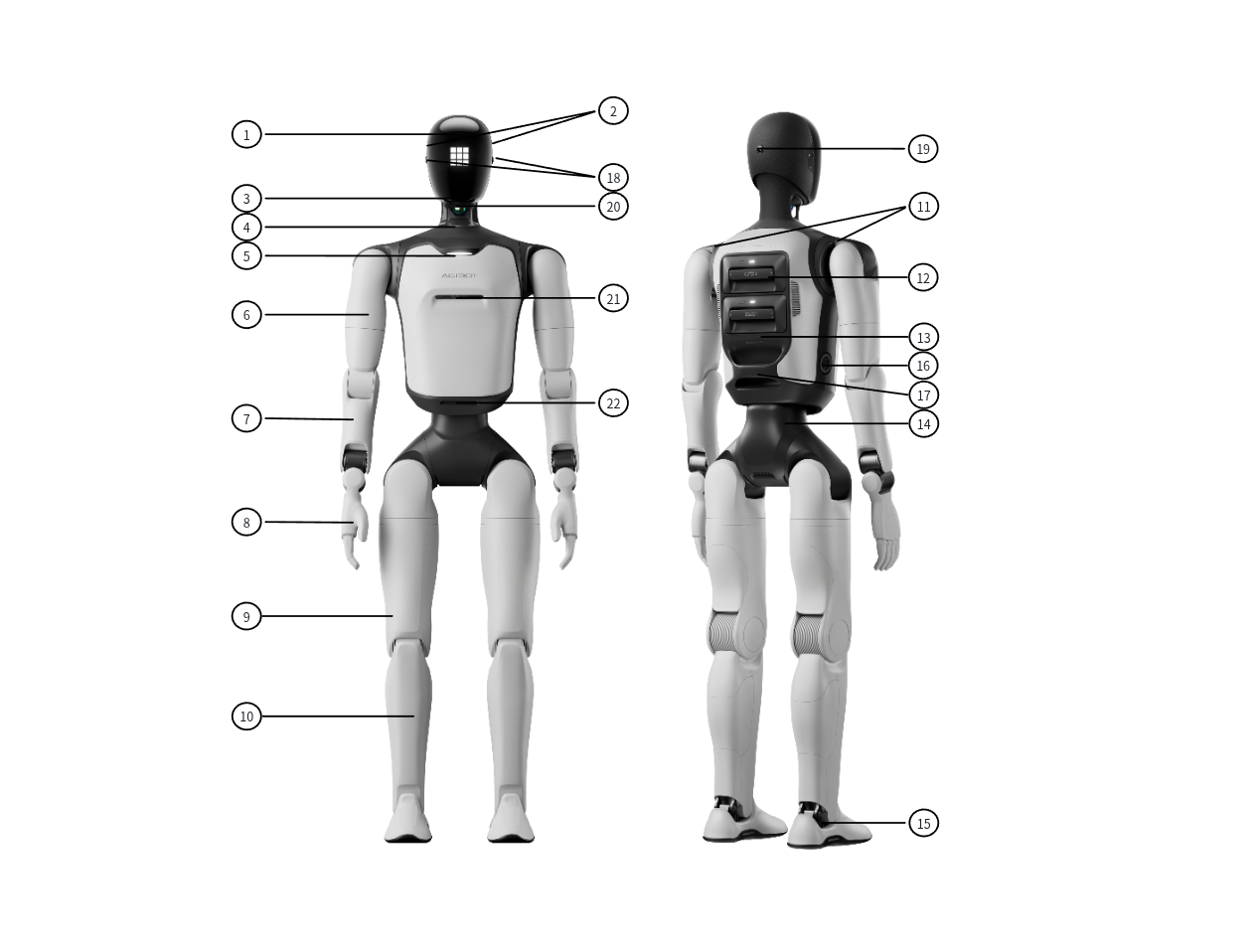
| No. | Name | No. | Name | No. | Name |
|---|---|---|---|---|---|
| 1 | Head Display Screen | 9 | Thigh | 17 | Waist Handle |
| 2 | Left and Right Speakers | 10 | Lower Leg | 18 | Left and Right Fisheye Cameras |
| 3 | Interactive Binocular Camera | 11 | Dual-Shoulder Touch Sensors | 19 | Rear Fisheye Camera |
| 4 | Power Switch | 12 | Dual Battery Compartments | 20 | LiDAR |
| 5 | Microphone | 13 | Service Compartment | 21 | Chest RGBD Camera |
| 6 | Upper Arm | 14 | Waist | 22 | Pelvis RGBD Camera |
| 7 | Forearm | 15 | Foot | ||
| 8 | Dexterous Hand | 16 | Charging Port |
1.2 Robot Specifications
| Robot Model | Expedition A3 Ultra | |
|---|---|---|
| Whole Robot | Height | 1.74 m |
| Dimensions | 174 cm (H) 52 cm (W) 30 cm (L) | |
| Weight | 60 kg | |
| Active Degrees of Freedom | 51 | |
| Neck Degrees of Freedom | 2 | |
| Single-Arm Degrees of Freedom | 7 | |
| Waist Degrees of Freedom | 3 | |
| Single-Leg Degrees of Freedom | 6 | |
| Dexterous Hand Degrees of Freedom | 10 (optional, supports up to 20 DOF) | |
| Perception System | 3D LiDAR | Available |
| Embodied Manipulation RGB-D Camera | Available | |
| Terrain Perception RGB-D Camera | Available | |
| Interactive RGB Camera | RGB binocular camera | |
| Surround-View RGB Camera | Available | |
| GPS | Available | |
| GPS RTK | Available | |
| UWB Positioning | Available | |
| Shoulder Touch Sensor | Available | |
| Communication | Communication Methods | WiFi, 4G/5G network, Bluetooth |
| Interaction | Microphone | Omnidirectional microphone pickup * Front and rear 8-microphone array |
| Speaker | Available | |
| Interactive Screen | Curved screen | |
| Indicator Light | Omnidirectional indicator light | |
| Performance | Peak Knee Joint Torque | 320 N·m |
| Movement Speed | Maximum daily walking speed: 1.8 m/s Daily walking speed: < 1.2 m/s Laboratory maximum speed: 2.5 m/s Top running speed: 5 m/s | |
| Single-Arm Payload | 5 kg | |
| Energy and Power | Battery Capacity | 1152 W·h |
| Battery Life | Overall endurance: 8 h * Actual endurance depends on usage conditions and is affected by walking speed and payload. Standing / walking duration ratio: 1:1 | |
| Charging Methods | Supports direct charging, battery swap, and autonomous charging | |
| Charging Time | Less than or equal to 2 h | |
| Charging Input Voltage | 110V-220V | |
| Computing Power | Basic Compute Board | RK3588*2 |
| Advanced Compute Board | NVIDIA Thor | |
| Other | Handheld Wireless Terminal | Available |
| Smart OTA Upgrade | Available | |
| Secondary Development | Supported |
1.3 Robot Joint Motion Range
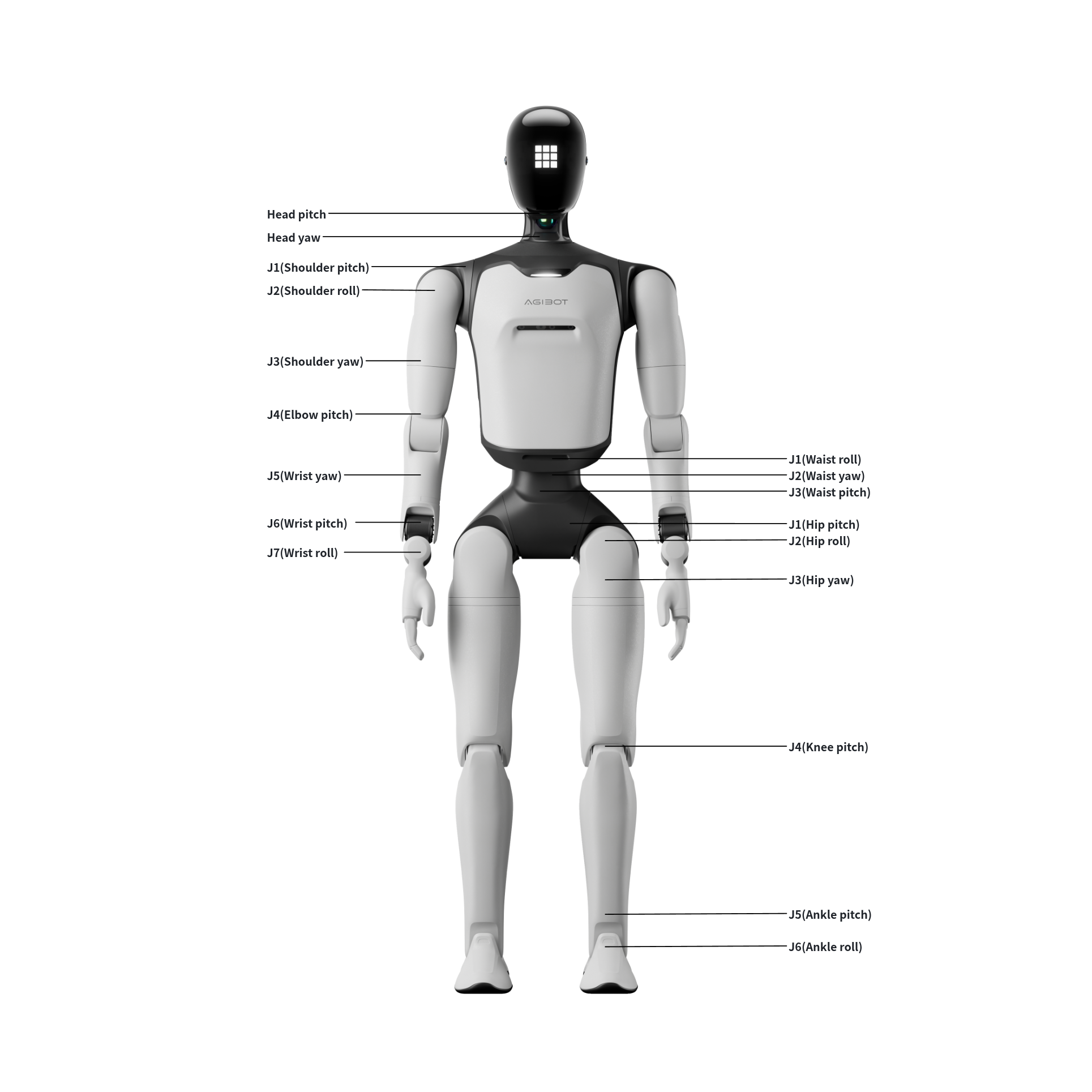
| Joint Name | Joint Limits | Joint Name | Joint Limits |
|---|---|---|---|
| Arm | J1 (Shoulder pitch): -170° to 170° | Waist | J1 (Waist roll): ±20° |
| J2 (Shoulder roll): -91° to 91° | J2 (Waist yaw): ±150° | ||
| J3 (Shoulder yaw): ±160° | J3 (Waist pitch): ±30° | ||
| J4 (Elbow pitch): -60° to 140° | Leg | J1 (Hip pitch): -168° to 154° | |
| J5 (Wrist yaw): ±160° | J2 (Hip roll): -60° to 100° | ||
| J6 (Wrist pitch): ±93° | J3 (Hip yaw): ±158° | ||
| J7 (Wrist roll): ±33° | J4 (Knee pitch): -10° to 148° | ||
| Head | Pitch joint (Head pitch): 15° down, 25° up | J5 (Ankle pitch): -52° to 30° | |
| Rotation joint (Head yaw): ±90° | J6 (Ankle roll): ±20° |
1.4 Robot Camera Field of View
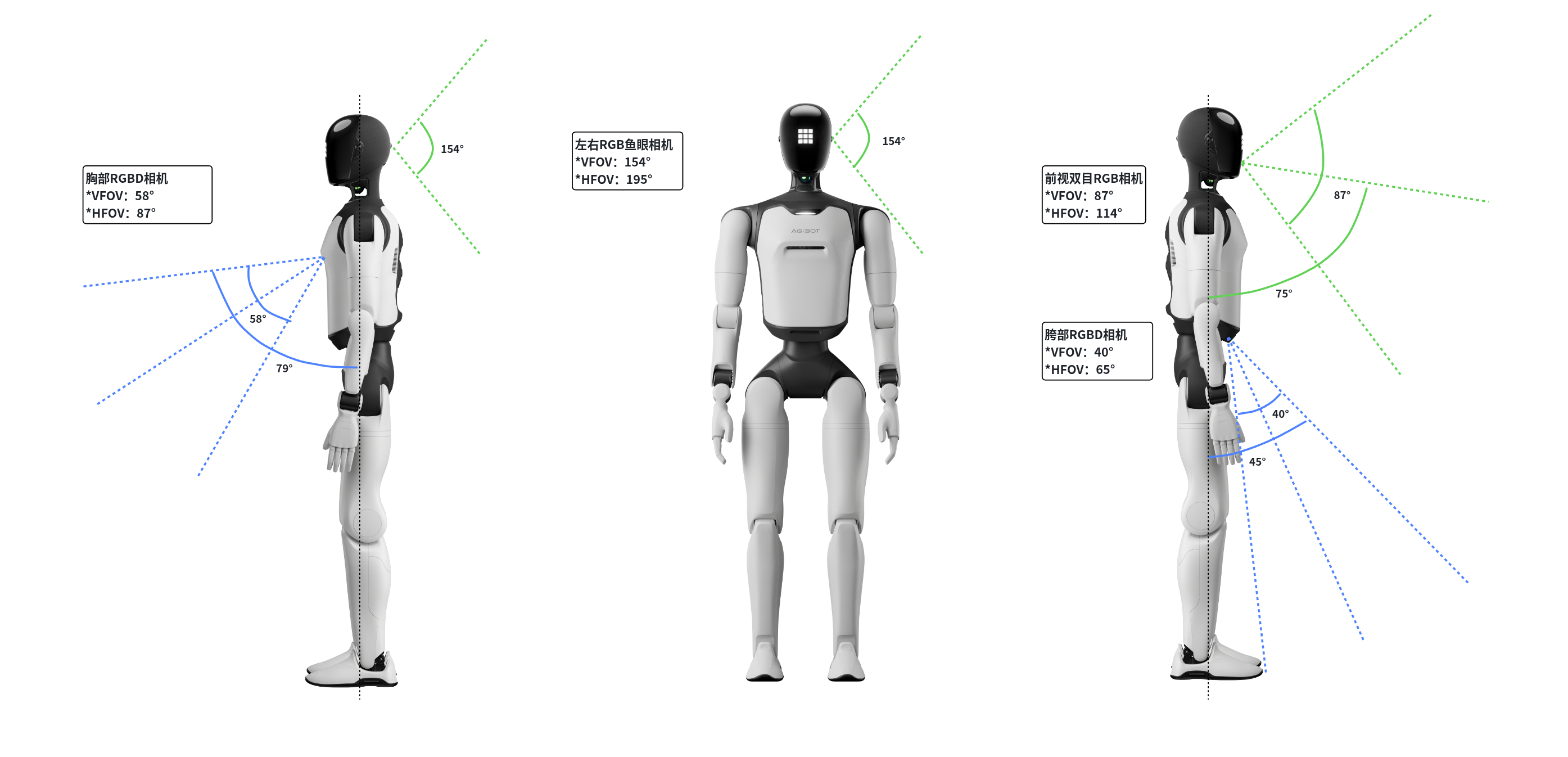
| Robot Model | Perception Configuration | Perception Capability |
|---|---|---|
| Expedition A3 Ultra | Interactive binocular camera | Supports visual recognition and response in human-robot interaction scenarios |
| Left and right fisheye cameras | Surrounding environment perception, object recognition, and obstacle avoidance | |
| Rear fisheye camera | ||
| Chest RGBD camera | Depth and image perception of the operation area | |
| Pelvis RGBD camera | Depth and image perception of the ground area |
1.5 Network Topology
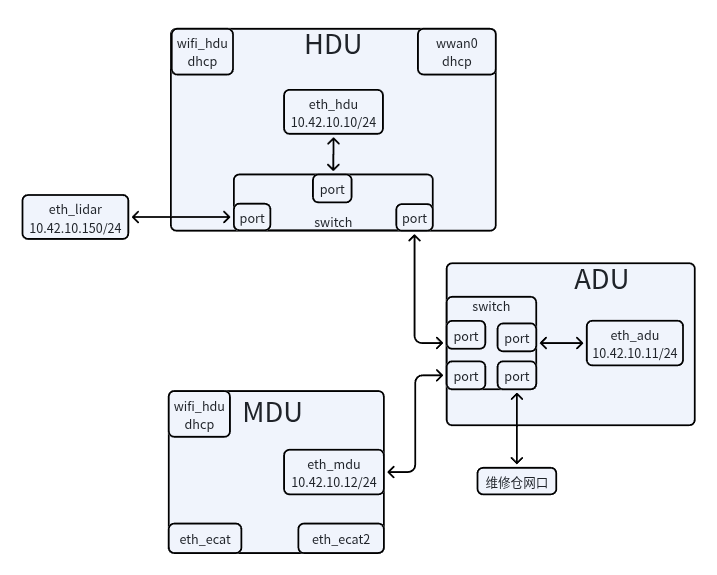
The HDU connects to the external network through WiFi and forms the robot's internal core network together with the MDU and ADU via eth_hdu (10.42.10.x). 5G serves as a backup link and can be used to connect to the external network when WiFi is unavailable.
1.6 Industrial PC Specifications
The robot system consists of three core computing units:
MDU (Motion Domain Unit): Based on the RK3588 industrial control platform, it integrates an SoC with better real-time performance to provide stable computing power for motion-control algorithm modules. It is also the hardware unit closest to the robot actuators.
HDU (Head Domain Unit): Based on the RK3588S2 platform, it integrates a compute SoC, network peripherals, GPS, and abundant sensor interfaces, providing intelligent interaction and control computing capability for head-related software and algorithm modules.
ADU (AGI Domain Unit): Based on the NVIDIA Thor platform, it integrates a high-performance compute SoC, a small number of peripherals, and rich sensor interfaces, mainly providing sufficient computing power for embodied intelligence algorithm modules.
For RK3588 series specifications, refer to the Rockchip official website, and for NVIDIA Thor platform specifications, refer to the NVIDIA official page.
The table below shows the hardware parameters of the three core computing units:
| Industrial PC | Hardware Type | Specifications |
|---|---|---|
| MDU | CPU | 8-core ARM big.LITTLE (4×A76 + 4×A55), up to 2.3 GHz, with L3 cache |
| Memory | 16 GB | |
| Disk Capacity | 256 GB | |
| HDU | CPU | 8-core ARM big.LITTLE architecture (4×A76 + 4×A55), up to 2.3 GHz |
| Memory | 16 GB | |
| Disk Capacity | 128 GB | |
| ADU | CPU | 12-core ARM (single cluster), up to 2.6 GHz, 12 MB L2 cache, supports SVE2 |
| Memory | 64 GB | |
| Disk Capacity | 358 GB |